
 Varun Sharma
There’s a moment in every competitive mobile match where skill alone stops being enough. The lobby is intense, the zone is closing, footsteps are everywhere, and for a split second, your screen stutters. Your aim drags late. The enemy peeks faster than your reaction. You lose the fight and instantly blame yourself.
Professional players don’t.
They blame the frame rate.
That’s the real reason serious esports players are obsessed with 90 FPS phones. It’s not marketing hype, flex culture, or expensive hardware addiction. In competitive gaming, smoother gameplay directly affects reaction time, accuracy, movement consistency, and even decision-making under pressure. High frame rates reduce input delay, improve motion clarity, and make aiming feel significantly more responsive.
Most casual players think FPS only changes how “smooth” a game looks. Pro players know it changes how the game feels.
And in esports, feeling matters more than graphics.
Why 60 FPS No Longer Feels Competitive
A few years ago, 60 FPS was considered premium mobile gaming. Today, it feels average.
Games like PUBG Mobile, Call of Duty: Mobile, and Free Fire MAX have become faster, more aggressive, and more movement-heavy than ever before. Players slide-cancel, jiggle peek, quick scope, and track targets at insane speed. At that level, frame drops become deadly.
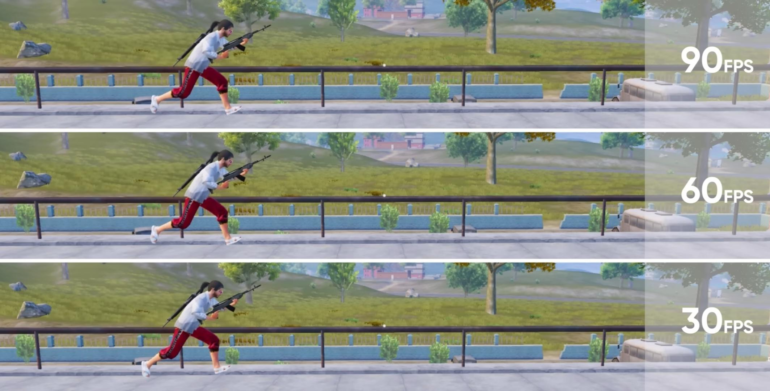
A 90 FPS device refreshes visuals more frequently than a 60 FPS phone, making motion appear smoother and reducing blur during fast camera movement.
That difference sounds small on paper.

In an actual gunfight, it changes everything.
When a player swipes during recoil control or tracks a moving enemy in close-range combat, the extra frames create smoother motion transitions. Enemies appear more clearly during movement, and aiming corrections feel more natural.
That’s why many esports players say going back to 60 FPS feels “heavy.”
The Hidden Advantage Nobody Talks About: Input Delay
Here’s the part most gaming creators ignore.
Professional players don’t just want smoother visuals. They want lower latency.
Every action in a mobile game has a tiny delay between your finger touching the screen and the game responding. That delay is called input lag. Lower latency systems improve aiming precision and reaction-based gameplay performance, especially in competitive shooters. (Wikipedia)
This is where flagship gaming phones separate themselves from budget devices.
Higher refresh rates combined with better touch sampling rates make controls feel more immediate. Your flicks register faster. Your sprays react quicker. Your micro-adjustments become sharper.
Even experienced ranked players on Reddit describe the jump from mid-range phones to flagship gaming devices as instantly noticeable, especially while aiming. Many specifically mention reduced input lag and smoother touch response as the biggest upgrade.
That advantage is difficult to explain unless you’ve experienced it yourself.
But pros notice it immediately.
Smoothness Improves Confidence
One thing esports coaches quietly admit is that stable frame rates affect confidence.
A player who trusts their device takes more aggressive fights.
A player dealing with frame drops hesitates.
Competitive gaming is deeply psychological. Tiny inconsistencies force the brain to constantly compensate. If movement feels delayed or recoil feels unpredictable, players subconsciously become slower and more defensive.
At 90 FPS, gameplay feels fluid enough that muscle memory becomes more reliable. Tracking enemies feels natural instead of forced. Close-range combat becomes less chaotic because visual motion is clearer and easier to read.
That’s one reason professional mobile esports evolved so quickly once high-refresh-rate phones became mainstream.
It’s Not Just About FPS — It’s About Stability
Interestingly, most pro players would choose stable 90 FPS over unstable 120 FPS.
Because consistency wins tournaments.
A phone that overheats after two matches becomes useless in scrims. Thermal throttling can suddenly drop frame rates mid-fight, ruining muscle memory and reaction timing. Gaming phones now focus heavily on cooling systems, vapor chambers, and sustained performance because long-term frame stability matters more than peak benchmark numbers.
That’s why esports players often prefer devices with aggressive cooling systems and gaming-focused optimization instead of camera-focused flagship phones.
In tournaments, stability is king.
The Difference Is Bigger Than Most Players Realize
Many casual gamers believe skill matters more than hardware.
They’re right.
But only to a point.
At lower ranks, raw skill easily beats expensive devices. At high ranks, where reaction times and aim accuracy are already strong, hardware advantages become impossible to ignore.
Even academic studies on esports latency show that lower system delay improves targeting performance in competitive first-person games.
That doesn’t mean a 90 FPS phone magically turns someone into a professional player.
It means it removes limitations.
And pro players hate limitations.
The Future of Mobile Esports Is Faster Than Ever
The push toward 90 FPS was only the beginning.
Modern gaming phones now support 120Hz and even 144Hz displays, while competitive mobile games continue optimizing for higher frame rates.
But even today, 90 FPS remains the sweet spot for many mobile esports players because it balances smoothness, battery life, thermals, and consistent performance.
That’s the real reason pros prefer 90 FPS phones.
Not because they look cooler.
Because when a match is decided in milliseconds, smoother gameplay stops being a luxury and becomes a competitive advantage.
Complete Steps to download the file.
1) Go to the Image you see and a random Website will open (wait for it to fully load).
2) Then copy the URL Link of the Website and paste it below in the text-box
3) Click on “send” to receive the Download Link